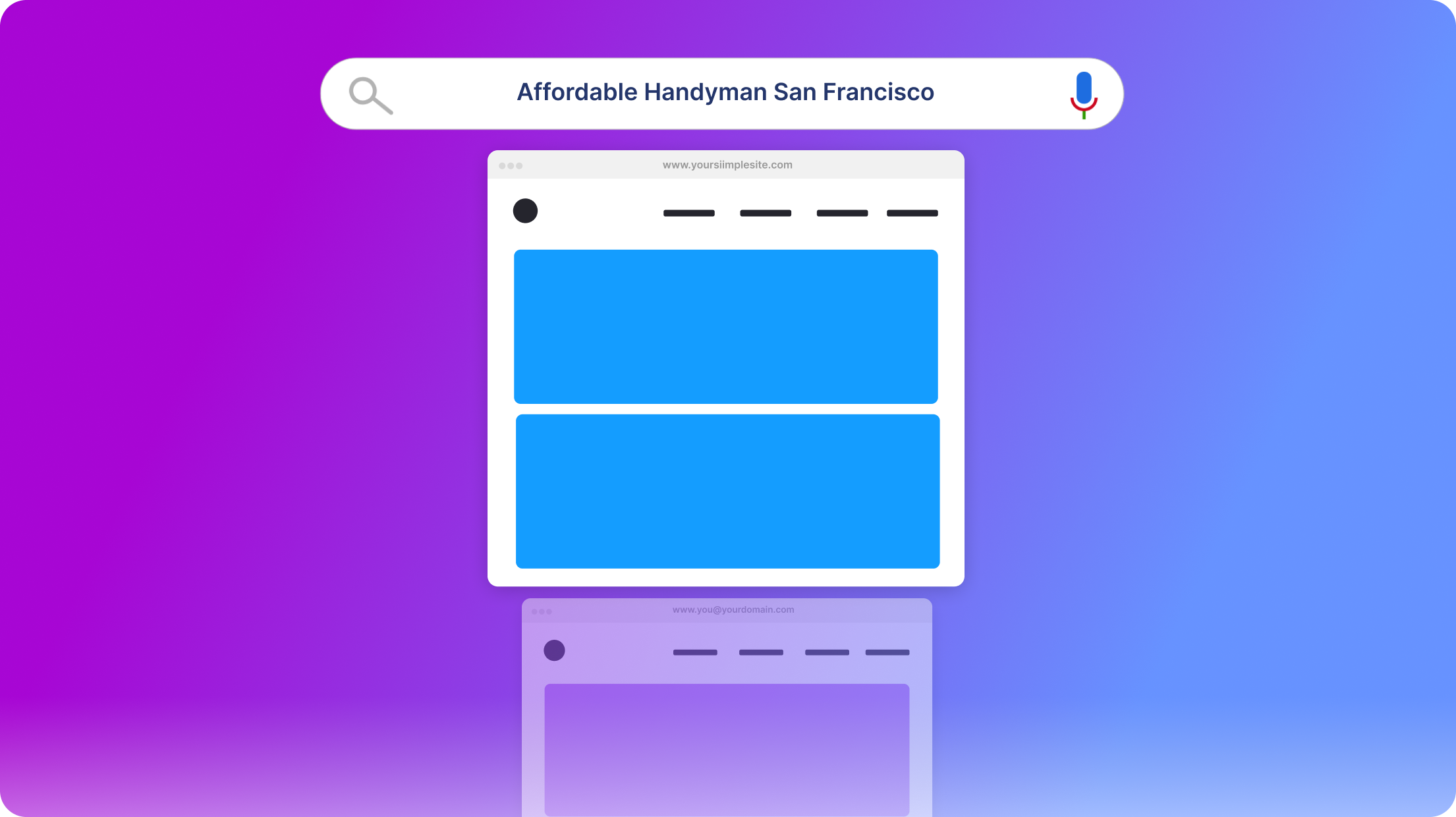
Years ago, simply creating a website was often enough for it to show up in search results. Today, that’s no longer the case.
Google now evaluates millions of websites competing for attention, and it needs signals to decide which ones to show, when, and for what searches. That process is what people refer to as Search Engine Optimization, or SEO.
For local and service-based businesses, SEO doesn’t have to be complicated — but it does require understanding how Google actually discovers and evaluates your website in the first place.
At a high level, Google looks at two broad categories of information:
- What’s on your website
- What exists about your business elsewhere on the internet
Before diving into SEO tactics, it helps to understand how Google’s process works.
The term SEO often feels overwhelming at first — especially when the advice you find online seems built for big companies with massive websites, marketing teams, and endless content budgets.
You’ll hear things like:
- “You need dozens of blog posts”
- “You need a page for every city”
- “You need a complex website structure”
But most real small businesses don’t operate that way.
They usually have:
- A Simple website
- One main service (or a small handful)
- A specific local area they serve
- Limited time to manage a website
- A site that exists to get inquiries, not to impress Google engineers
That’s exactly what this guide focuses – SEO for local and small businesses using a one-page website — and how you can still rank, get found, and turn visitors into customers without turning your site into something complicated or hard to maintain.
When it comes to SEO, helps to understand one core concept that everything else builds on: the difference between on-page SEO and off-page SEO — together they shape how, and whether or not your site appears in search results.
How Google Discovers and Shows Websites
When you publish a new website, Google doesn’t automatically “know” it exists.
Instead, it uses a three-step process to find and display sites in search results:
crawling, indexing, and ranking.
1. Crawling: How Google Finds New Websites
Google uses automated programs called crawlers (sometimes called spiders) to continuously scan the web.
These crawlers discover new websites in a few main ways:
- By following links from other websites
- Through submitted sitemaps
- When new URLs are detected through known platforms
The important thing to understand is this:
Google usually finds new sites through other sites.
If your website has no links pointing to it yet, discovery can be slower. This is especially common for new local businesses and one-page websites, which often launch without any external connections.
2. Indexing: How Google Understands Your Site
Once Google finds your website, it doesn’t rank it immediately.
First, it tries to understand what the site is about.
During indexing, Google analyzes:
- The text on the page
- Headings and structure
- Images and image descriptions
- Page titles and descriptions
- How the site is coded and organized
This information is stored in Google’s index — essentially a massive database of web pages.
If your site is unclear, poorly structured, or missing context (such as what services you offer or where you operate), Google may index it incompletely or incorrectly.
3. Ranking: How Google Decides When to Show Your Site
After your site is indexed, Google decides when (or if) to show it for specific searches.
Ranking is based on many factors, including:
- How relevant your site is to a search query
- How clearly your services and location are described
- How usable the site is on mobile devices
- How fast the site loads
Whether other websites reference or link to your business
Older, established websites with strong external signals tend to have an advantage — not because they’re bigger, but because they’ve accumulated trust over time.
Why This Matters for Local and One-Page Websites
For small, local businesses, the goal isn’t to compete with massive companies or content-heavy websites.
The goal is to:
- Clearly explain what you do
- Clearly state where you do it
Make it easy for Google to understand and trust your business
A well-structured one-page website can absolutely do this — as long as it sends the right signals both on the site and off the site.
That’s why the rest of this guide focuses on:
- How on-page SEO works on simple, one-page websites
2. How off-page SEO builds trust and visibility over time
3. How these two work together to help your site get found
From here, we’ll break down on-page SEO first, then move into off-page SEO and backlinks — all through the lens of local and service-based businesses.
On-Page SEO vs Off-Page SEO (And Why Both Matter)
SEO is usually broken into two categories: on-page SEO and off-page SEO. These terms get thrown around a lot, but they’re often explained in a way that assumes you’re technical — or that every website tool works the same way. That’s not reality for most small businesses.
Type 1: On-Page SEO
On-page SEO refers to everything that happens on your website itself — the content, structure, and signals Google reads to understand what your business does and who it’s for.
This includes things like:
- The visible text on your website (headlines, paragraphs, service descriptions)
- How headings are structured (H1s, H2s, section hierarchy)
- Keywords and locations mentioned throughout the page
- Image alt text and how images are loaded
- Page titles and meta descriptions
- The order and emphasis of sections on the page
- The underlying code structure of the site
- How clean and readable the HTML is
- Whether the site loads efficiently
- How sections are marked up for search engines
- Whether the site is mobile-friendly and responsive
This last part is often overlooked — especially in beginner SEO advice.
On-page SEO doesn’t automatically mean something you personally control, understand, or even have access to.
Many website builders:
- Lock down or abstract the code entirely
- Don’t use proper heading hierarchy
- Generate bloated or confusing markup
- Make it hard (or impossible) to change SEO-relevant structure
- Require technical knowledge to fix things you didn’t even realize were problems
For non-technical business owners, this can turn SEO into a silent problem. Your site might look fine, but under the hood it may be sending weak, mixed, or incomplete signals to search engines — and you’d have no easy way to know or fix it.
This is where pre-built, opinionated templates can make a real difference — specifically for simple websites and non-technical business owners.
For simple websites and non-technical, service-based businesses, this is where a website builder like Siimple is a great choice.
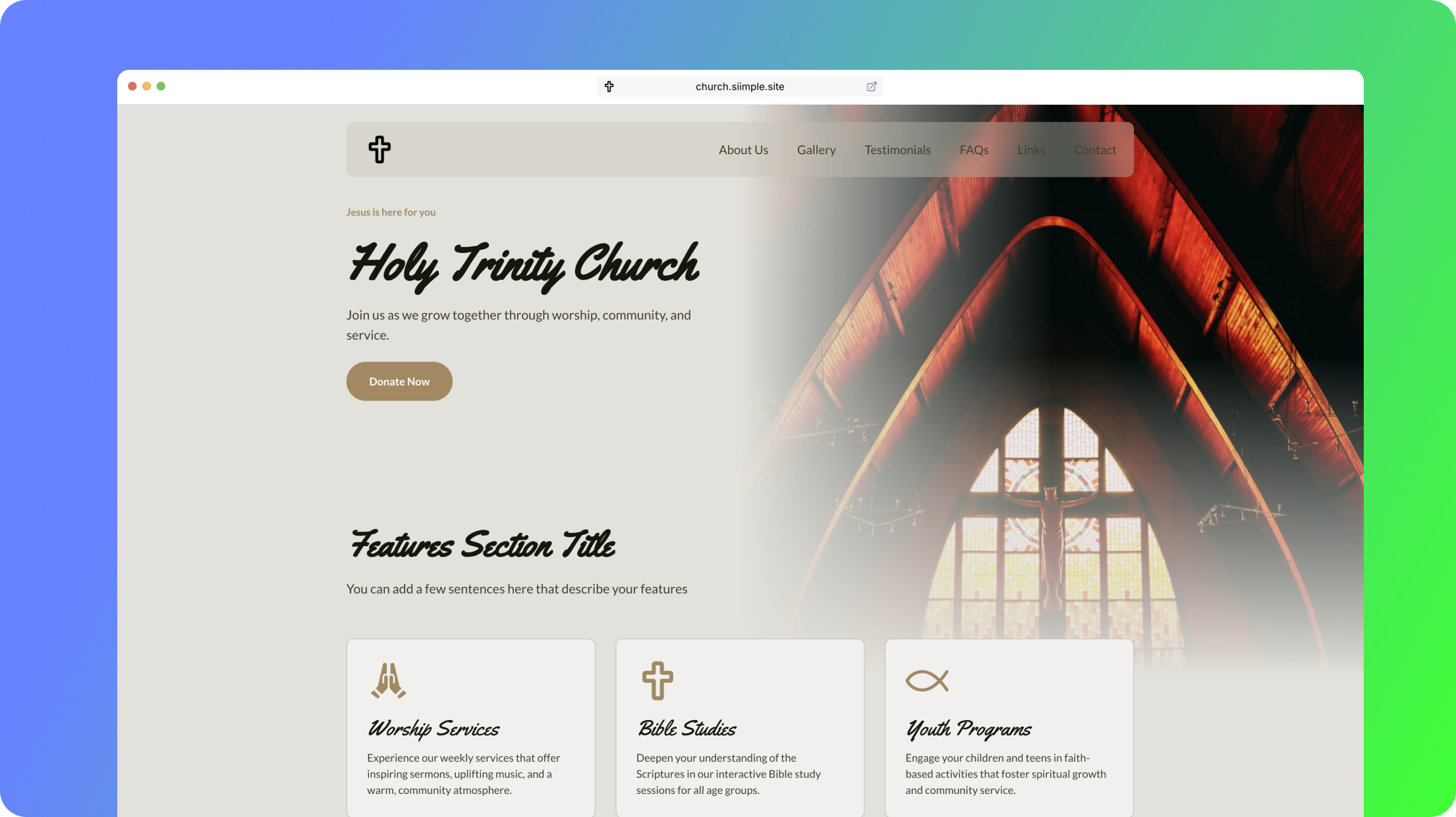
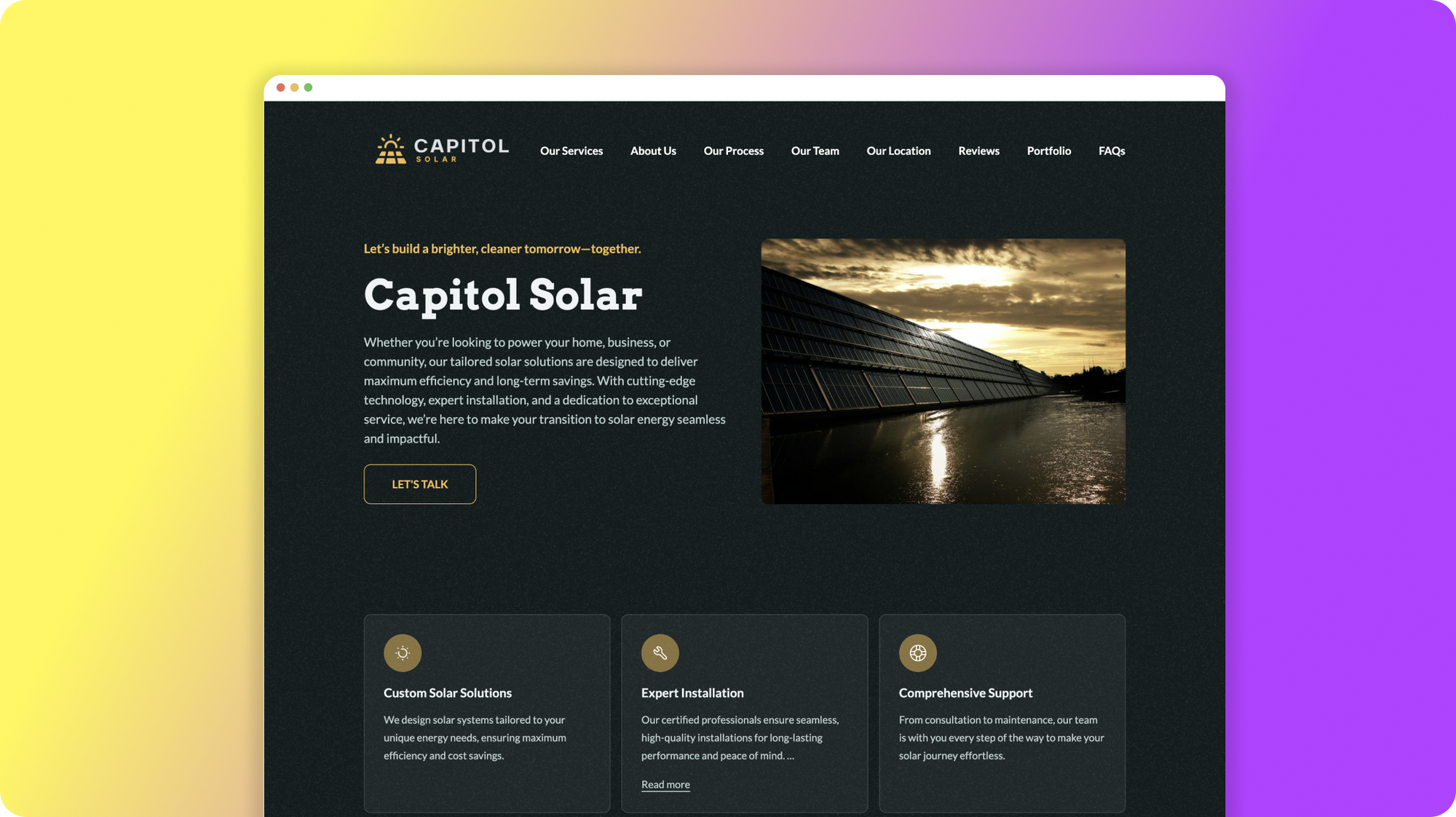
Siimple is built for beginners who need a straightforward website — typically a one-page or brochure-style site — where the SEO basics are handled at the structural level. Things like clean code, sensible heading structure, mobile-friendly layouts, and performance-conscious markup are already taken care of, so business owners don’t have to think about technical setup.
Templated websites tend to work best when the goal is clarity, speed, and simplicity — especially for local and service-based businesses.
They’re a good fit when:
- The website is one page or brochure-style
- The business offers a clear set of services
- The service area is local or region-specific
- The person managing the site is non-technical
- SEO fundamentals need to be in place without manual setup
In these cases, much of the on-page SEO work happens at the structural level. The way the site is coded, how headings are organized, how sections are marked up, and how the site behaves on mobile are already accounted for. This removes a major source of friction for beginners, who may not know — or want to know — how SEO is implemented behind the scenes.
The role of the business owner then becomes much more focused and practical:
- Clearly describing what they do
- Using the same language their customers use when searching
- Mentioning the locations they serve throughout the site
- Adding proof, credibility, and trust signals
This is often enough to perform very well in local search.
For many local service businesses, starting with a templated site that removes unnecessary technical decisions can make SEO more approachable — and more effective.
Type 2: Off-Page SEO (The Most Overlooked Part of SEO)
This is everything that happens outside your website:
This includes things like:
- Backlinks from other websites
- Mentions of your business across the web
- Business listings and directories
- Reviews and ratings
- Social media activity
- Citations that include your business name, address, and phone number
While on-page SEO helps Google understand what your business does, off-page SEO helps Google decide:
“Do other people on the internet acknowledge and trust this business?”
For local and service-based businesses, this is often the most influential part of SEO — and also the most neglected.
Most SEO problems happen when businesses focus on one and ignore the other.
A beautiful website with no backlinks won’t rank.
A business with backlinks but unclear on-page content won’t convert.
The goal is alignment — and that’s where a well-structured one-page site actually shines.
Why Off-Page SEO Gets Ignored
Off-page SEO is overlooked for a few simple reasons.
First, it’s less visible.
You can see your website. You can edit text. You can change sections and headlines. Off-page SEO happens in places you don’t log into every day — directories, third-party platforms, other people’s websites. Because it’s out of sight, it often falls out of mind.
Second, it doesn’t feel like “website work.”
Many business owners assume SEO is something you do to your website. They spend time tweaking copy, adjusting layouts, or changing keywords, while completely overlooking the fact that Google is also watching how often — and where — their business shows up elsewhere online.
Third, it’s rarely explained in practical terms.
Off-page SEO is often described vaguely as “build backlinks” or “increase authority,” without explaining what that actually looks like for a local business that isn’t trying to rank nationally or publish content every week.
As a result, many small businesses end up with:
- A decent website
- Clear services
- Good on-page SEO foundations…but very little external validation.
Why Off-Page SEO Matters So Much for Local Businesses
Local SEO is competitive in a very specific way.
You’re not competing with the entire internet — you’re competing with:
- Other businesses in your city
- Other service providers in your category
- Businesses with longer histories or stronger local footprints
In these cases, off-page signals often become the deciding factor.
If Google sees:
- Multiple directory listings confirming your business details
- Reviews from real customers
- Mentions on local or industry-relevant sites
- Social profiles tied to your brand
It becomes much easier for Google to trust that your business is real, active, and relevant to local searches.
A simple website with strong off-page signals will often outperform a more complex website with none.
So now that you understand the difference between these two, let's get into tactics and strategies for improving them, starting with on-page SEO
📄 On-Page SEO Strategies that Work For Simple Websites
A one-page website does not mean “bad for SEO.”
What matters is:
- Clarity
- Intent
- Consistency
Google doesn’t rank “pages.”
Google ranks answers.
A single page can rank extremely well if:
- It clearly states what the business does
- It clearly states where the business operates
- It reinforces that message across sections
- It’s supported by off-page signals
This is why Siimple templates are built with intent-based sections, not generic layouts.
Each section becomes a signal:
✅ Hero = who you are + where
✅ Services = what you offer
✅ Proof = why trust you
✅ Contact = how to take action
You’re not trying to trick Google.
You’re trying to remove ambiguity.
Keywords: What They Actually Mean for Local SEO
Keywords aren’t about stuffing phrases everywhere.
They’re about matching how people search.
A local customer doesn’t search:
“Best digital solution provider”
They search:
“Handyman in Austin”
“Mobile auto detailing near me”
“Licensed electrician San Diego”
Your website needs to reflect real language, not marketing language.
The 3 Types of Keywords That Matter
1. Primary Service + Location
This is your foundation.
Examples:
- Handyman in Phoenix
- Massage therapist in Portland
- House cleaning service in Tampa
This keyword should appear:
✅ In your hero headline
✅ In your first paragraph
✅ In your meta title
✅ In your image alt text
✅ In your contact section
✅ In your services or offerings if you have them
2. Secondary Service Variations
These support your main keyword.
Examples:
- Emergency repairs
- Same-day service
- Licensed & insured
- Residential and commercial
These belong in:
✅ Services sections
✅ Bullet points
✅ Section descriptions
3. Trust & Intent Keywords
These help conversion and SEO.
Examples:
- Affordable
- Trusted
- Local
- Family-owned
- Serving [City] since [Year]
Google doesn’t just rank relevance — it ranks credibility signals.
Example: How to Use Page Sections on a One-Page Site for better on-page SEO
Let’s look at a handyman serving Austin, Texas and how on-page SEO is built across a one-page website using both core and optional sections.
The important thing to understand is that SEO on a one-page site doesn’t come from one perfect headline. It comes from repeating clear, consistent signals across sections that each serve a different purpose.
Navigation
The navigation might be simple — Services, Areas Served, Reviews, Contact — but even this helps establish structure.
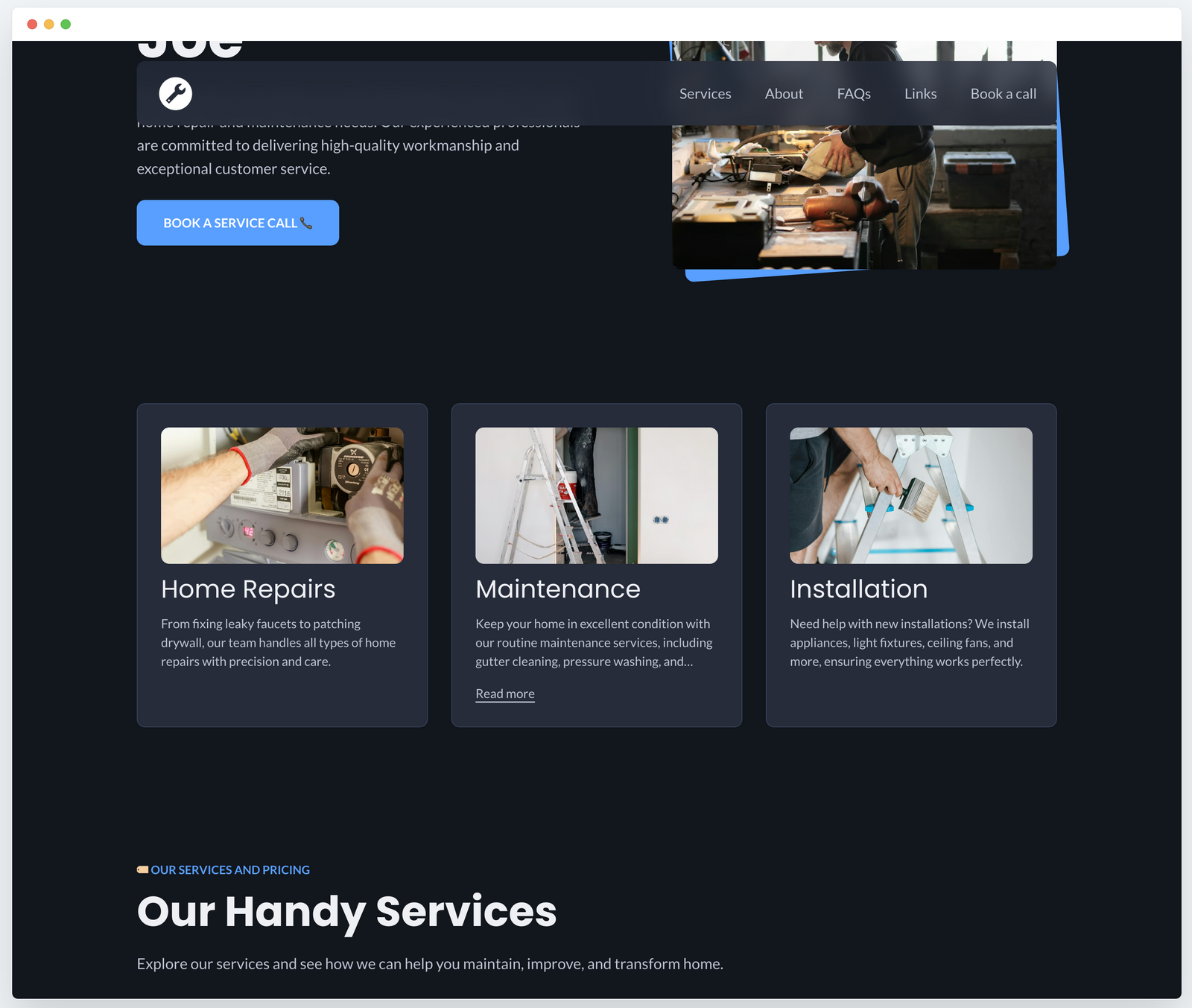
Clear labels tell search engines:
- What content exists on the page
- How information is grouped
- What matters most
A nav item like “Areas Served” or “Locations” immediately reinforces local relevance.
Header (Hero) Section
The header (or hero) section is where your website clearly introduces your business to both visitors and search engines.
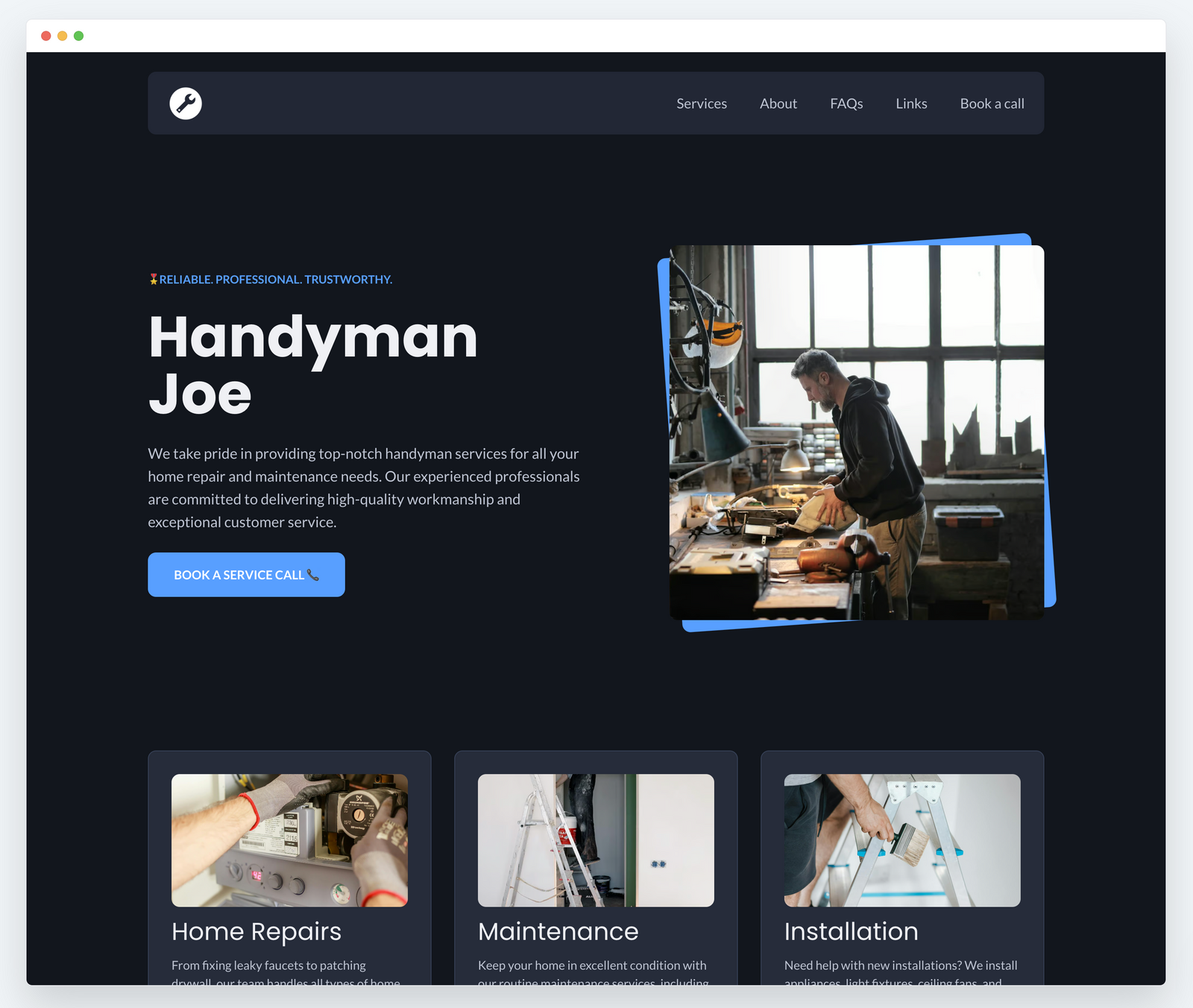
It’s usually the first thing people see and the first place Google looks to understand what your site is about.
For local and service-based businesses, this section works best when it plainly states what you do and where you do it, using the same language your customers would use when searching. A clear, descriptive headline paired with a short supporting line helps set the context for the rest of the page, making it easier for search engines to interpret every section that follows.
Search engines don’t want clever slogans here.
They want clarity.
Your hero should answer three questions, as directly as possible:
- What is this business?
- Where does it operate?
- What type of services does it provide?
For example, this works extremely well for local SEO:
Reliable Handyman Services in Austin
Repairs, Installations, and Small Home Projects
In two lines, this tells Google:
The service category (handyman services)
The location (Austin)
The scope of work (repairs, installations, home projects)
There’s no guessing involved.
Features / Benefits Section
The Features (or Benefits) section helps translate what you offer into reasons someone should choose you. From an SEO perspective, this section supports your main service by adding context — it explains how you work, what makes your service usable in real life, and what customers can expect when they reach out.
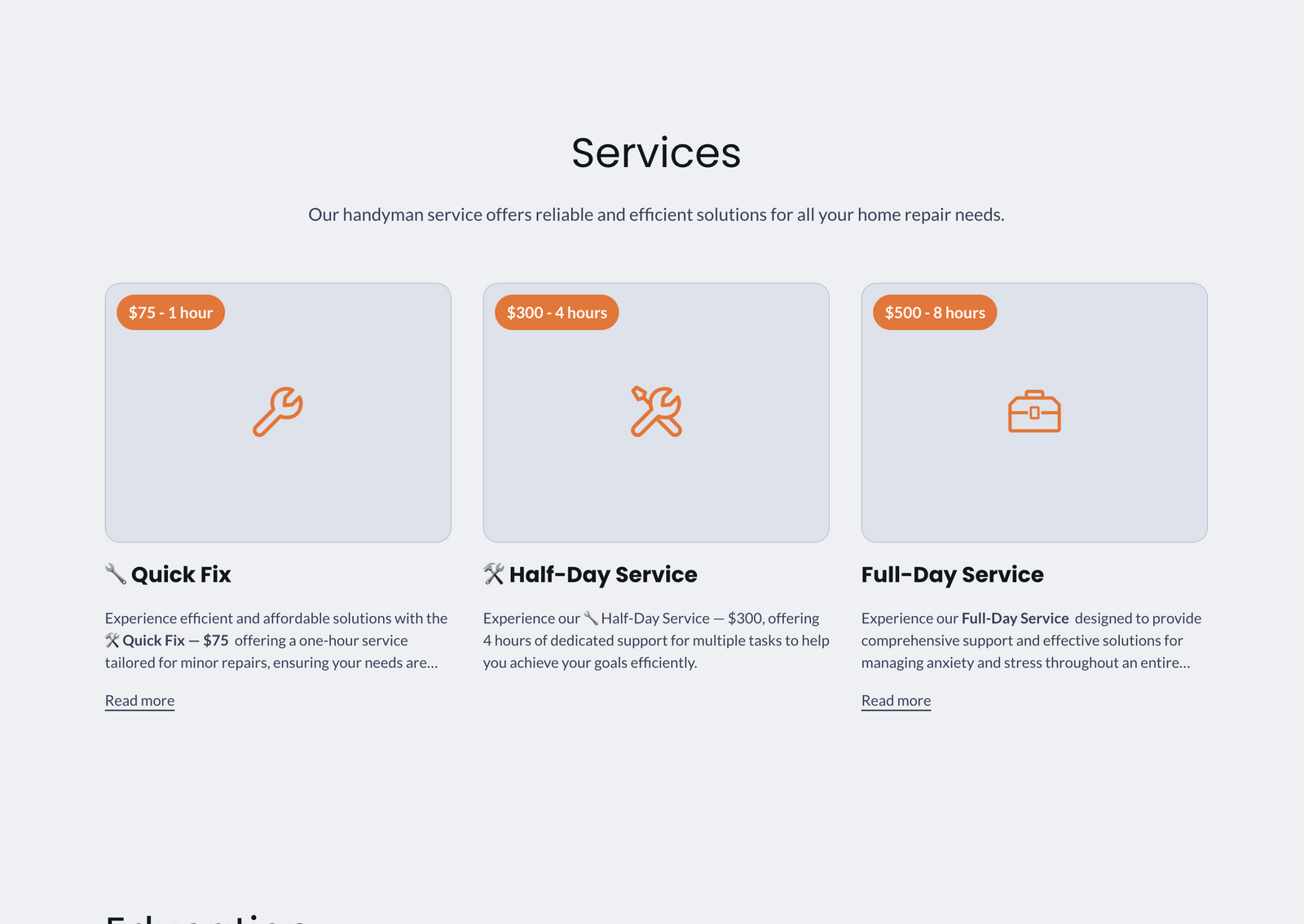
Unlike the Services section, which focuses on what you do, the Features section focuses on how you do it. This is where phrases like service area, availability, credentials, and approach naturally belong.
Examples:
- Serving Austin and surrounding neighborhoods
- Licensed, insured, and experienced
- Small jobs welcome — no job too minor
These phrases mirror how real people describe what they want, which helps with both SEO and conversion.
Offerings / Services Section
The Offerings (or Services) section is where your website stops being generic and starts being searchable.
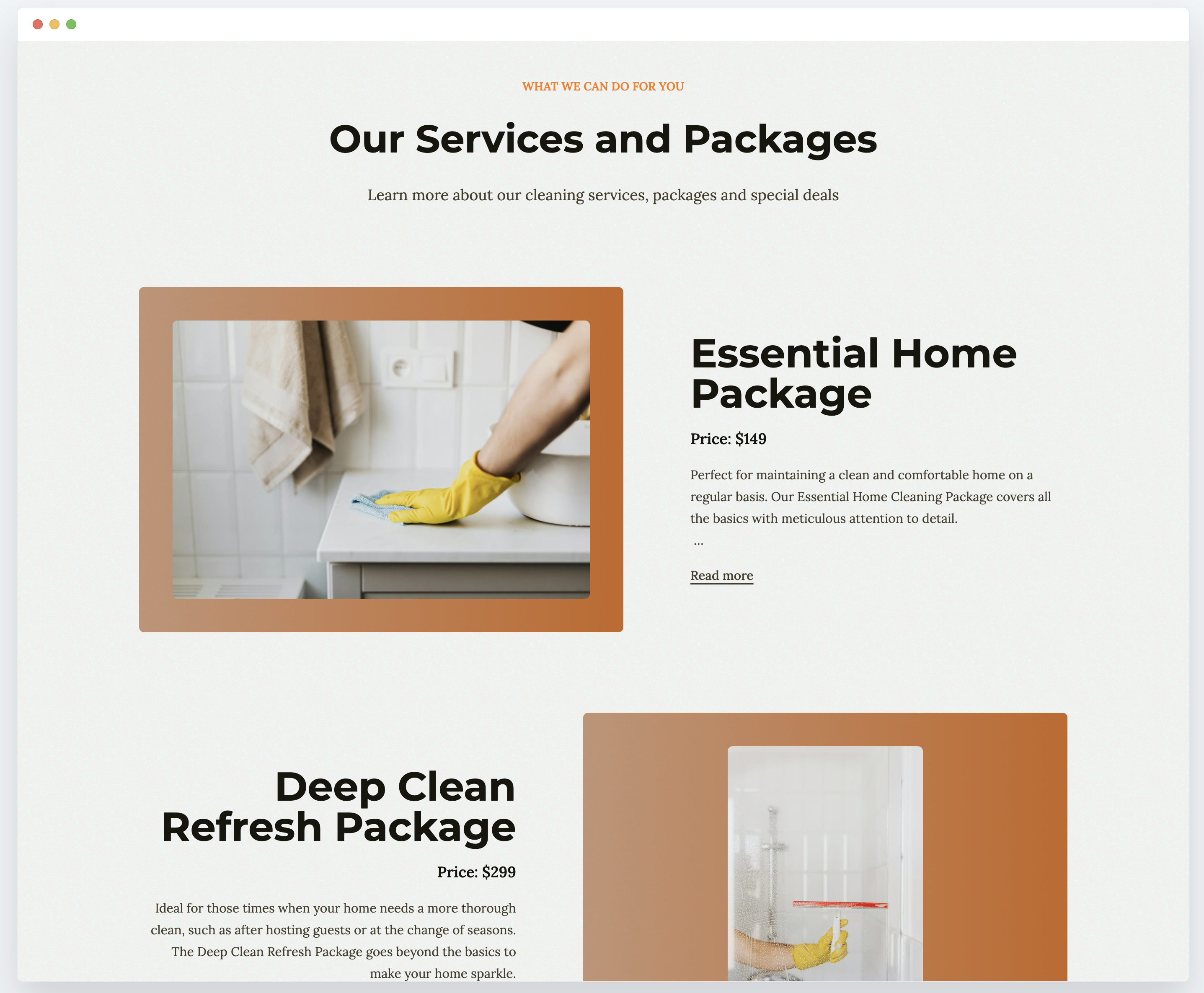
For local SEO, this section does a very specific job:
it tells Google exactly what types of work you do — not just your job title.
Many small business websites make the mistake of keeping this section too vague. They’ll say things like:
“We offer high-quality services tailored to your needs.”
That sounds fine to a human, but it gives search engines almost nothing to work with.
Google doesn’t rank businesses for being “helpful” or “high-quality.”
It ranks businesses for specific services people search for. This is where secondary and long-tail keywords live.
Each service item should map to a real search behavior.
A short description under each service is often more effective than a long paragraph.
For example:
Deep Cleaning Services
Thorough, detailed cleaning for buildup, neglected areas, or seasonal refreshes.
Banner / CTA Section
This section is critical for local service businesses.
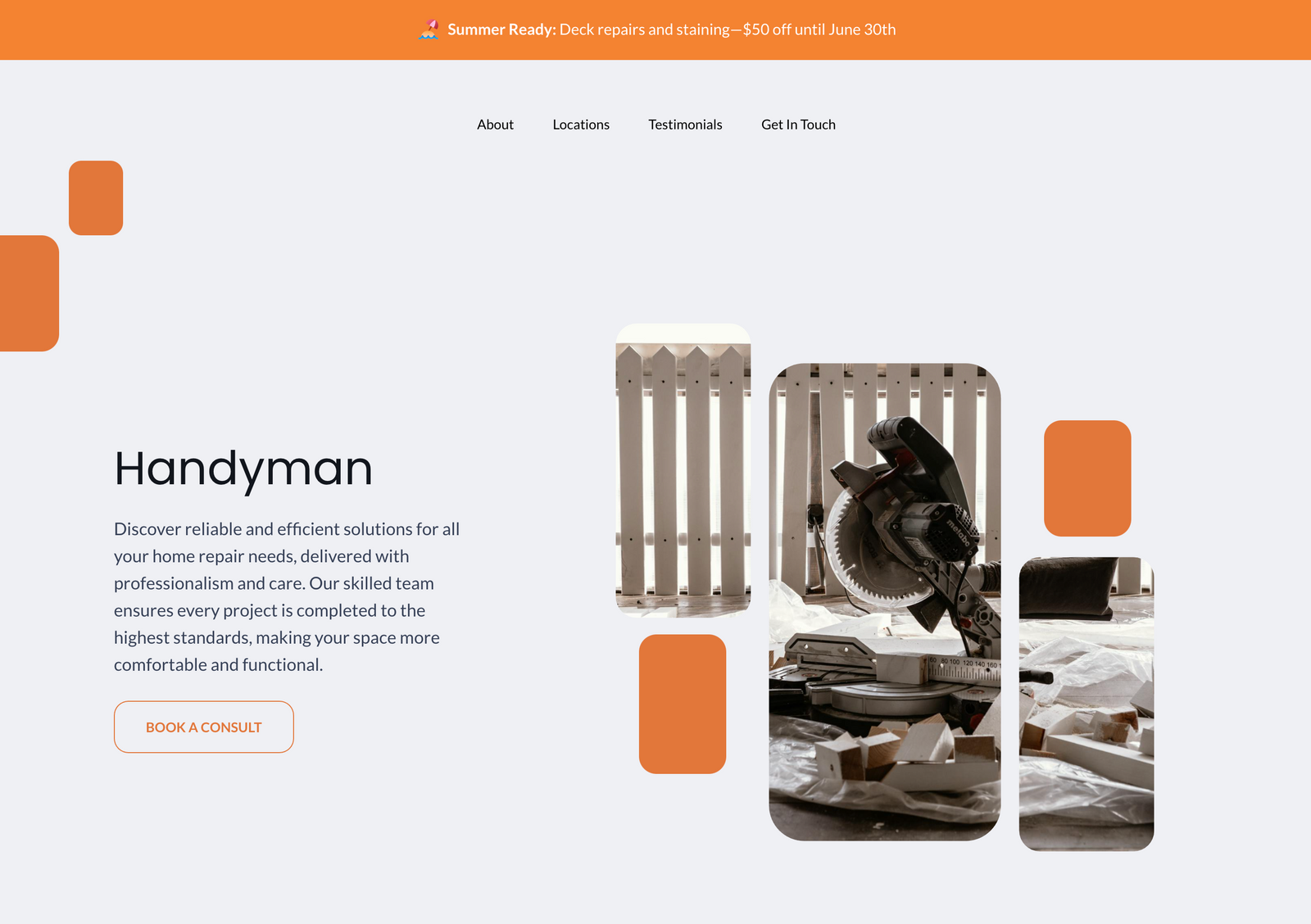
Example banner:
Need a Handyman in Austin? Call (512) 555-0187
Why this matters:
- Phone number is front and center
- Location is repeated naturally
- CTA aligns with high-intent searches
- Search engines associate this with a real, local service provider.
Badges Section
The Badges section exists for one primary reason: trust.
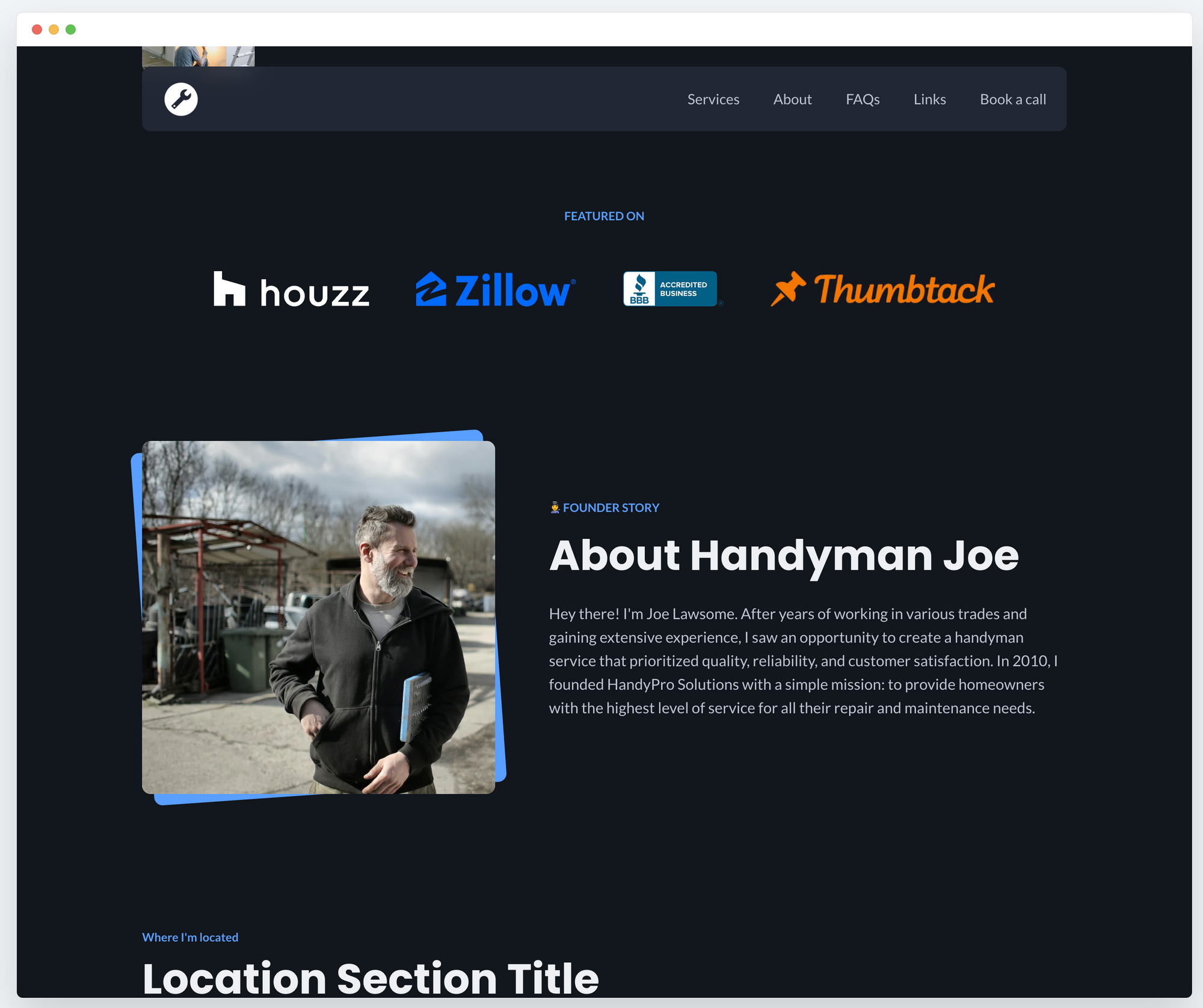
For local and service-based businesses, trust is not just a conversion factor — it’s also a ranking signal. Search engines are constantly trying to distinguish real, credible businesses from low-quality or temporary ones. Badges help do that quickly.
What Badges Signal to Search Engines
Badges help reinforce several important things at once:
Legitimacy
Signals that your business meets recognized standards (licensed, insured, certified, accredited).
Professional context
Shows that your business belongs to a real industry, trade, or organization.
External validation
Especially when badges link to third-party sites that confirm your status.
Examples:
- Licensing boards
- Insurance providers
- Trade organizations
- Professional associations
- Background check or verification services
- Local chambers of commerce
When these badges link to profiles or verification pages, they create a contextual backlink — even if it’s not a traditional blog-style link. This helps search engines understand that your business exists beyond your own website.
Gallery Section
For local and service-based businesses, the Gallery section does more than show off your work — it acts as visual confirmation of what you do and where you do it.
Search engines don’t just read text. They also analyze images, image metadata, and how visuals relate to the surrounding content on the page. When your gallery is done well, it reinforces the same signals you’re already sending with your headlines and service descriptions.

A handyman gallery might show:
- Before-and-after repair
- Mounted TVs, shelving, or fixtures
- Completed jobs in real homes
With alt text like that label with location or service
“Drywall repair in Austin living room”
What Google Learns From a Gallery Section
A properly structured gallery helps search engines understand:
The type of work you actually perform
(not just what you claim to do in text)
The kinds of jobs you take on
(small repairs, full installs, residential vs commercial, etc.)
The local nature of your business
especially when images reflect real homes, neighborhoods, studios, or venues
When your gallery shows real work — not generic stock photos — it strengthens trust signals for both users and search engines.
Testimonials Section
Testimonials often include natural, keyword-rich language.
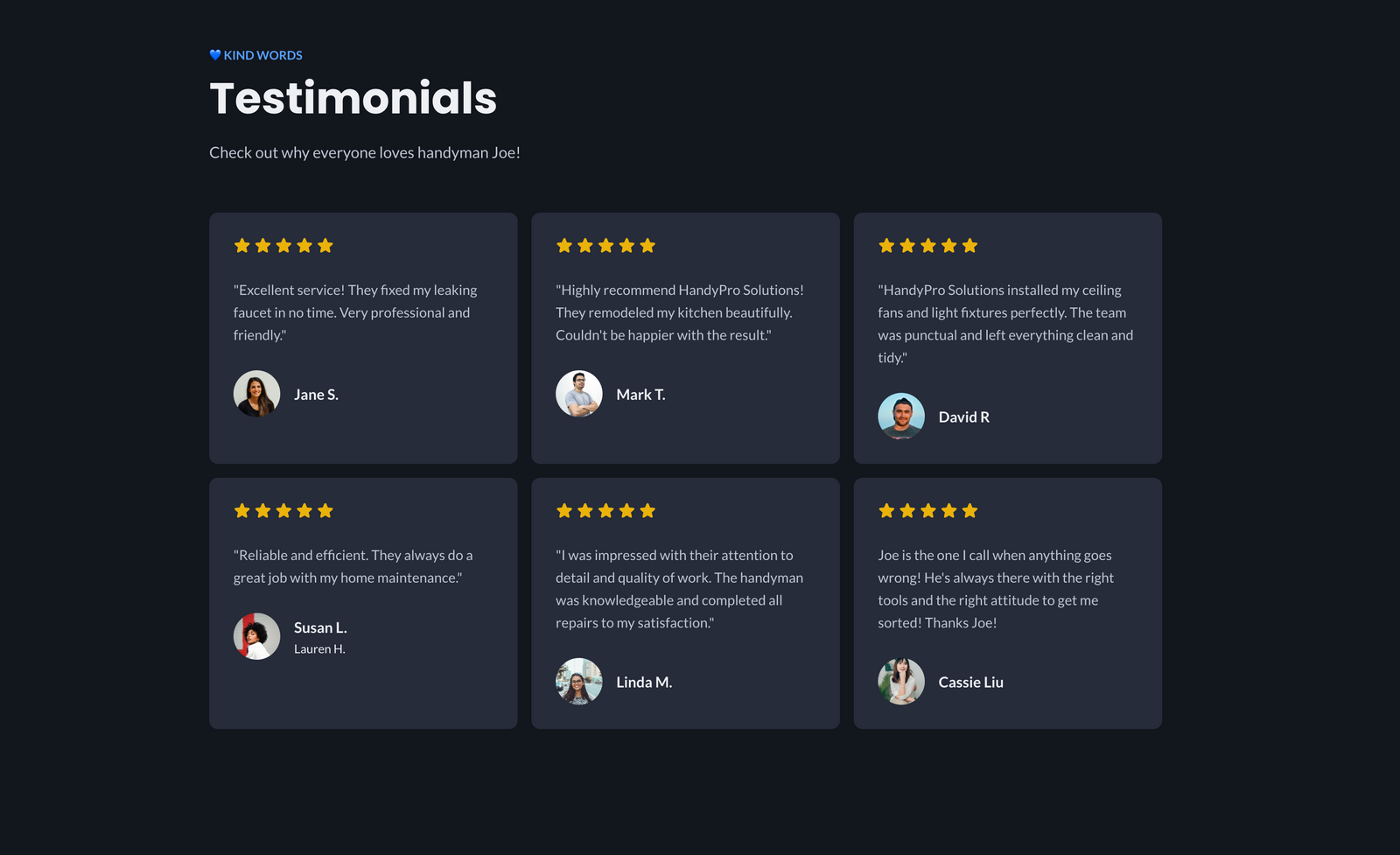
Example:
“We hired them for several small repairs in South Austin and everything was done perfectly.”
This type of language helps search engines understand service + location context.
Locations Section
For local and service-based businesses, your location isn’t just informational — it’s a ranking signal.
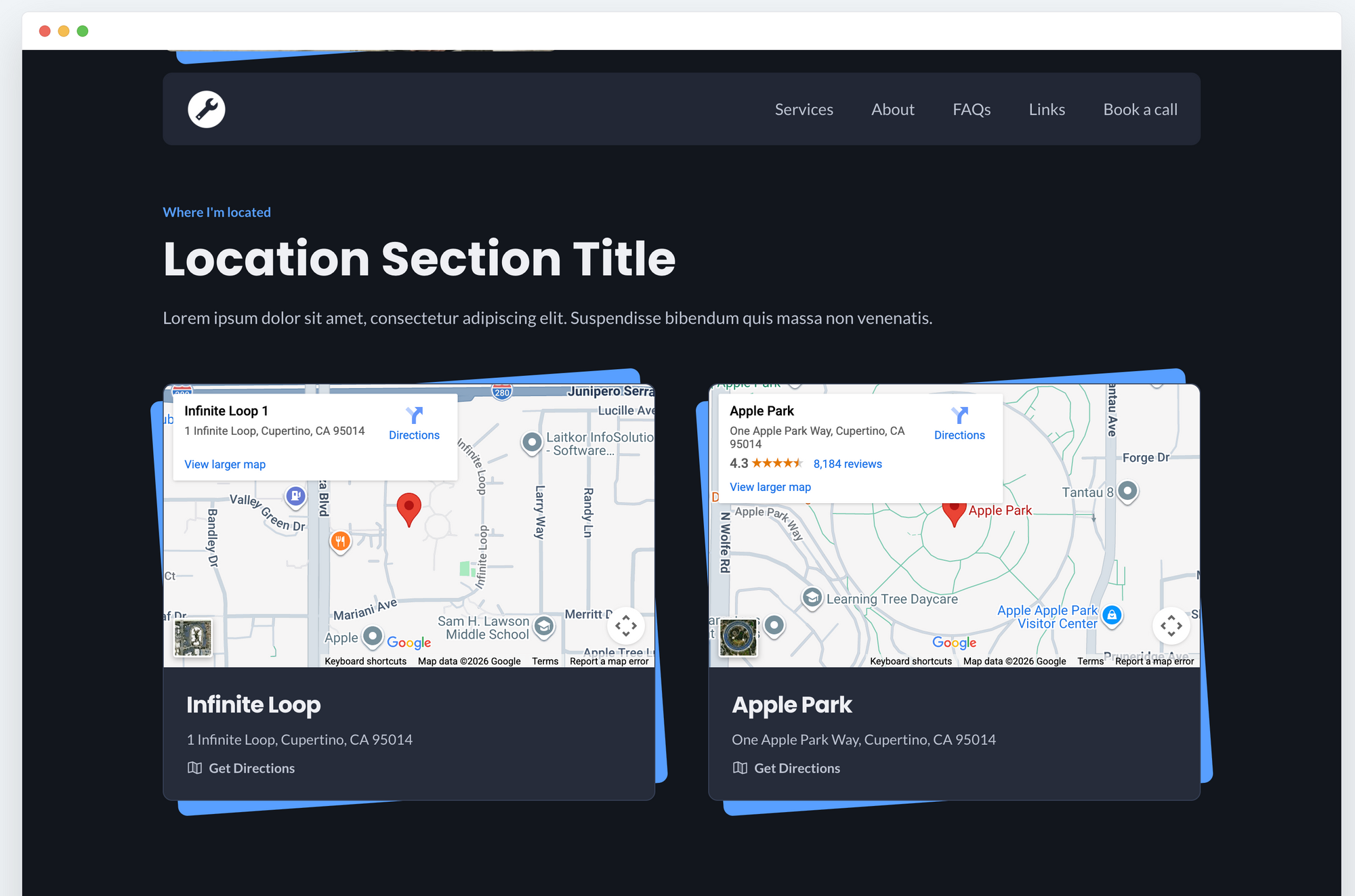
One of the simplest and most effective ways to reinforce that signal is by embedding a Google Map directly into your website’s Locations section.
When you embed a Google Map, you’re doing more than showing visitors where you’re located. You’re helping search engines connect your business to a real, physical place.
What a Google Map Embed Signals to Search Engines
An embedded map reinforces several important things at once:
- Your business operates in a real geographic area
- Your service area is tied to specific cities or neighborhoods
- Your website is connected to the same location data used by Google Business Profiles
This consistency matters. When Google sees the same location information reflected across:
✅ Your website
✅ Your embedded map
✅ Your business listings
This strengthens confidence that your business is legitimate and local.
FAQ Section
FAQ sections are often treated as an afterthought — a place to answer a few basic questions at the bottom of the page. In reality, FAQs are one of the most powerful and flexible SEO sections on a one-page website, especially for local and service-based businesses.
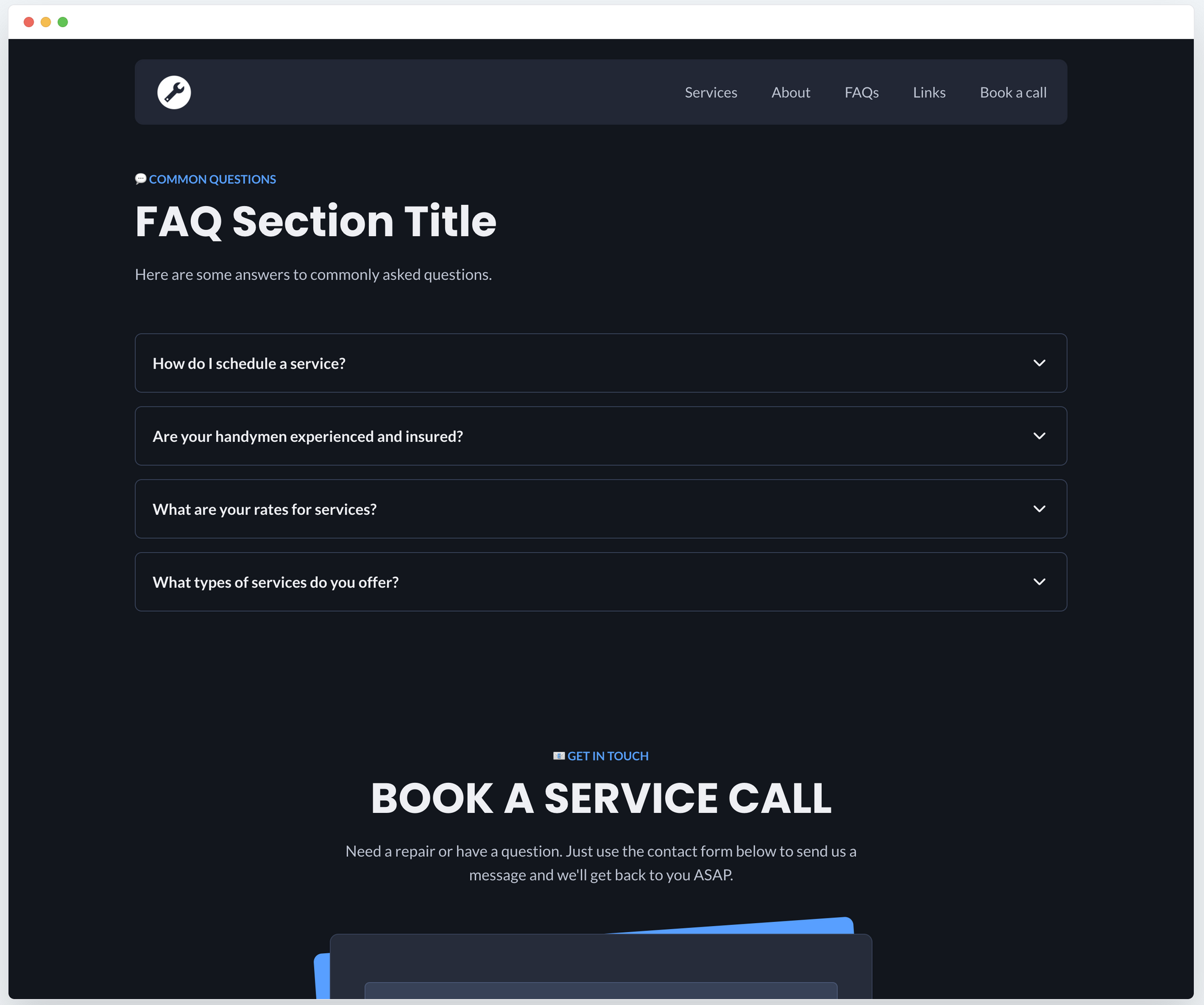
That’s because FAQs sit at the intersection of:
- How people actually search
- How search engines interpret intent
- How trust is built quickly
When done well, FAQs quietly do a lot of SEO work without feeling like SEO at all.
Why FAQs Matter for Local SEO
Most local searches aren’t short or perfectly phrased.
People search things like:
- “Do handymen do small jobs?”
- “How much does a handyman cost in Austin?”
- “What areas around Austin do you serve?”
- “Are you licensed and insured?”
- “Can I book same-day service?”
These are real questions, typed exactly as-is into Google.
An FAQ section allows your website to:
- Match natural language searches
- Capture long-tail keywords
- Clarify intent without adding new pages
- Reduce uncertainty before someone contacts you
For one-page websites, FAQs often do the job that blog posts or support pages would do on larger sites.
Timeline Section
The Timeline section is a simple way to show experience and continuity — especially for service-based businesses where trust matters.
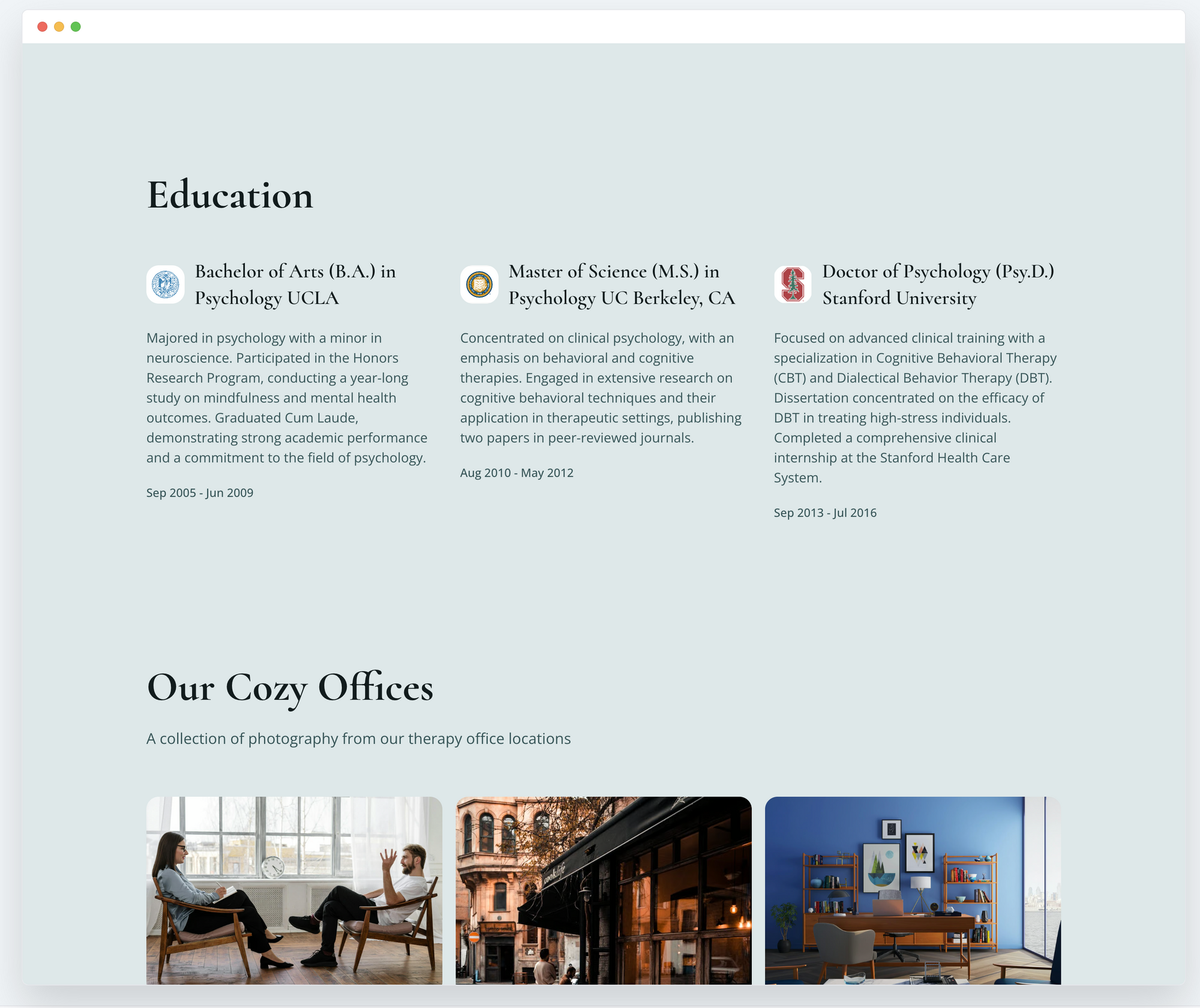
For a psychologist or therapist for example, this might include:
- Where they graduated from
- Certifications or trainings completed
- Places they've taught at
- When they opened their practice
- When they started offering services locally
This helps visitors (and search engines) understand that the business didn’t appear overnight and that the instructor has real, relevant experience.
On a one-page website, the Timeline section often replaces a longer “About” page. It gives just enough context to answer the quiet question most people have before reaching out:
“How long have you been doing this?”
Kept simple and factual, this section adds credibility without needing extra pages or technical setup.
Team Section
The Team section helps establish trust by making it clear that the business is run by real, qualified people — not just a logo or a service name.
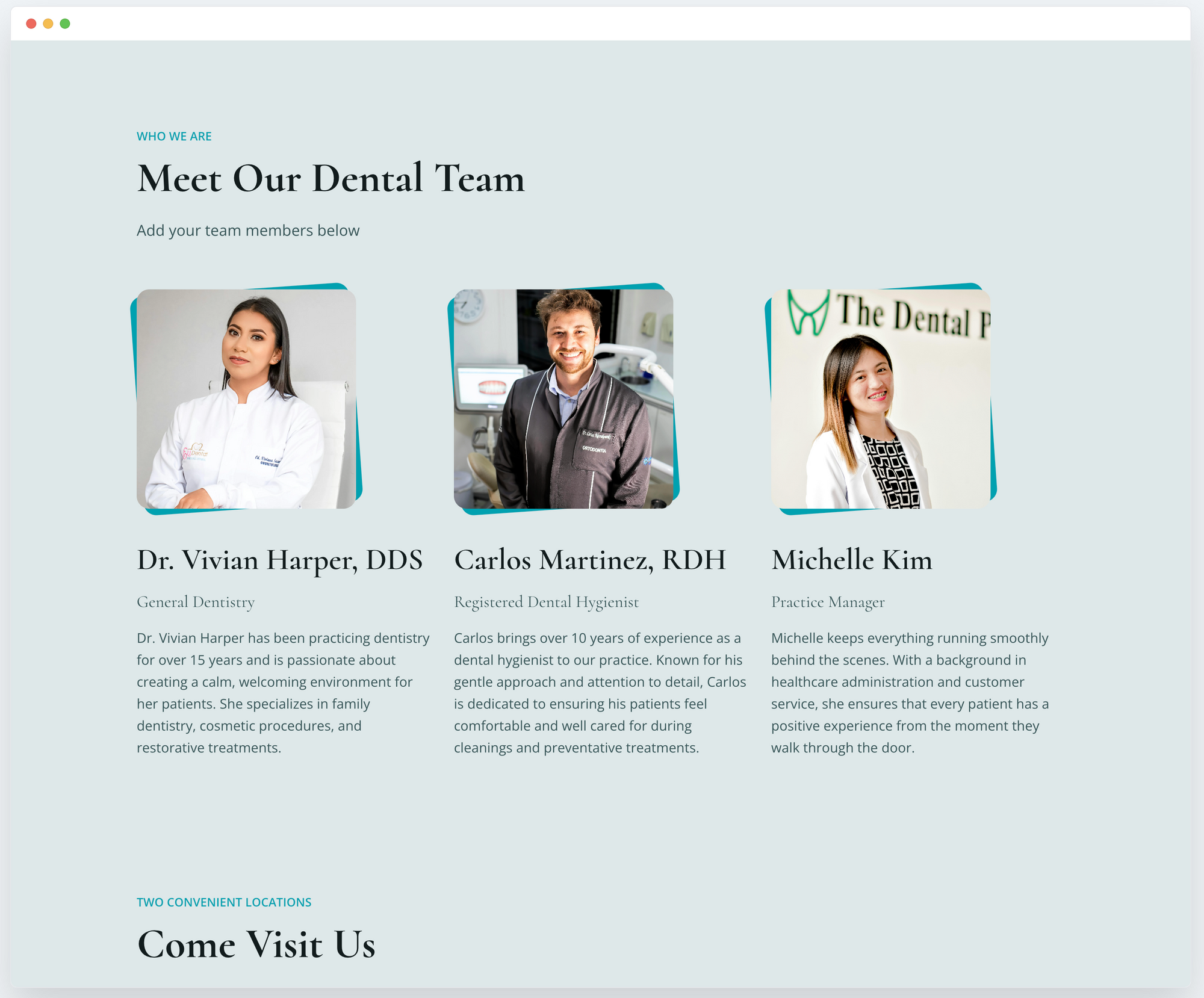
It does this by:
- Associating real names with the business entity
- Reinforcing professional roles and qualifications
- Connecting people → practice → location
For example, a short bio for dental teams might naturally include phrases like:
“General dentist in San Diego”
“Cosmetic and family dentistry”
“Serving patients across downtown San Diego”
These kinds of phrases help search engines associate real people with real services and a real location — without stuffing keywords into main headings.
Linking to relevant professional social profiles (such as LinkedIn or a professional Instagram account) adds another layer of credibility. It helps reinforce that the people listed are real practitioners with an active presence beyond the website, which supports overall trust signals.
On a one-page site, the Team section often carries more weight than it would on a larger site. When written clearly and factually, short bios can quietly support SEO while also helping visitors feel confident about who they’re choosing.
Video Embed
Embedded videos aren’t just for engagement — when used thoughtfully, they help reinforce who you are, what you do, and where you operate.
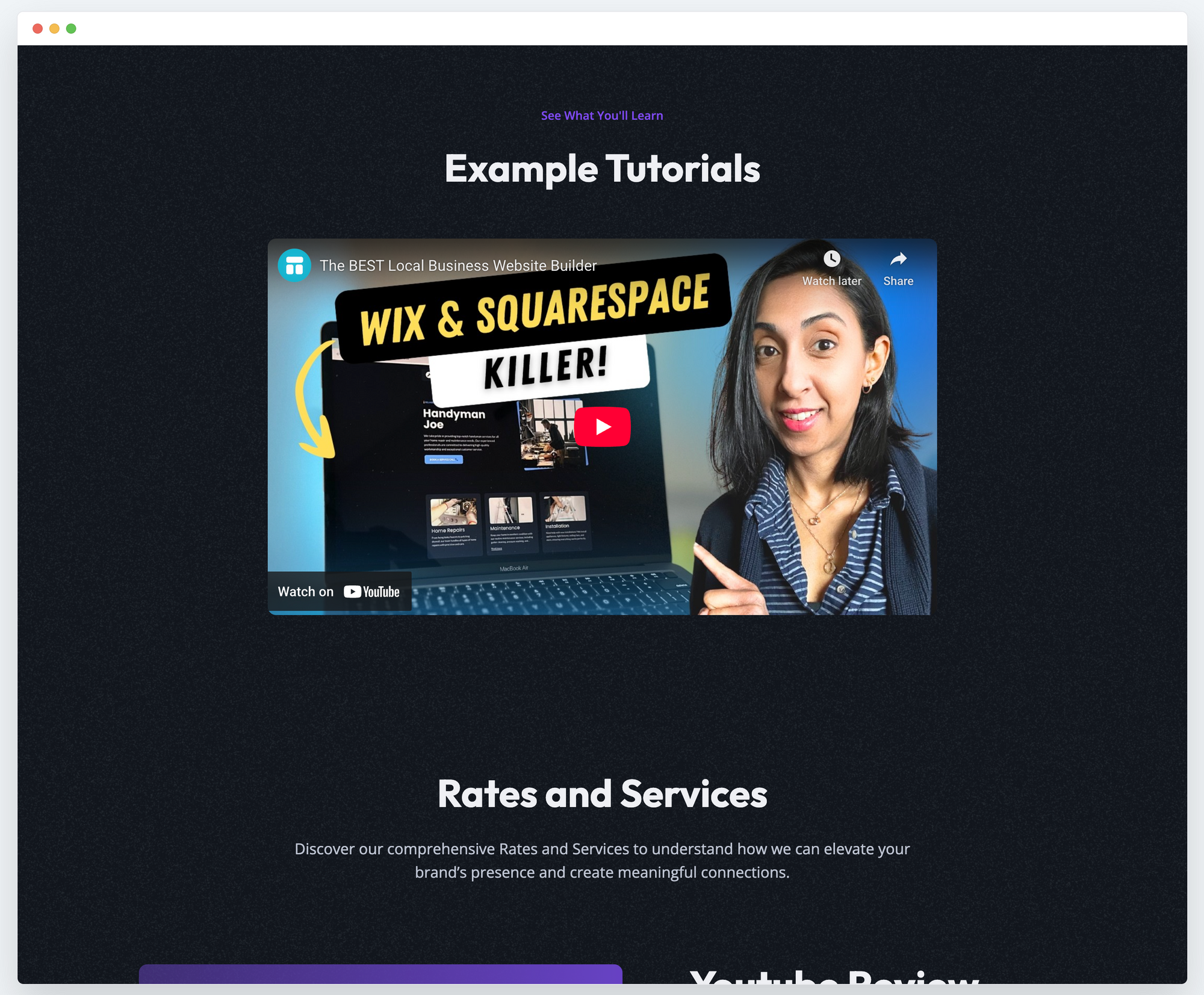
For local and service-based businesses, an embedded YouTube or Vimeo video often serves as a short introduction: who’s behind the business, what clients can expect, or how the service works. This can be especially helpful on a one-page site, where video adds depth without adding more sections or pages.
What matters most is how the video is described, not just that it exists.
How to use the video description to your SEO advantage
Search engines don’t “watch” your video. They rely heavily on:
- The video title
- The description text
- How the video is embedded and labeled on the page
That means the description you write on YouTube or Vimeo plays a role in how that video is understood — and how it connects back to your website.
A good description doesn’t try to rank on its own. It simply explains the video clearly and consistently.
For a musician, a good description might naturally mention:
- Your band name or stage name
- The type of music you make
- Where you’re based or perform
- What the video represents (live set, single release, rehearsal, etc.)
Written plainly, this helps search engines connect:
the video → the person → the practice → the location.
Calendar Embed / Appointment Scheduler
A Calendar section helps show that your business is active, bookable, and operating in the real world — which matters for both trust and clarity.
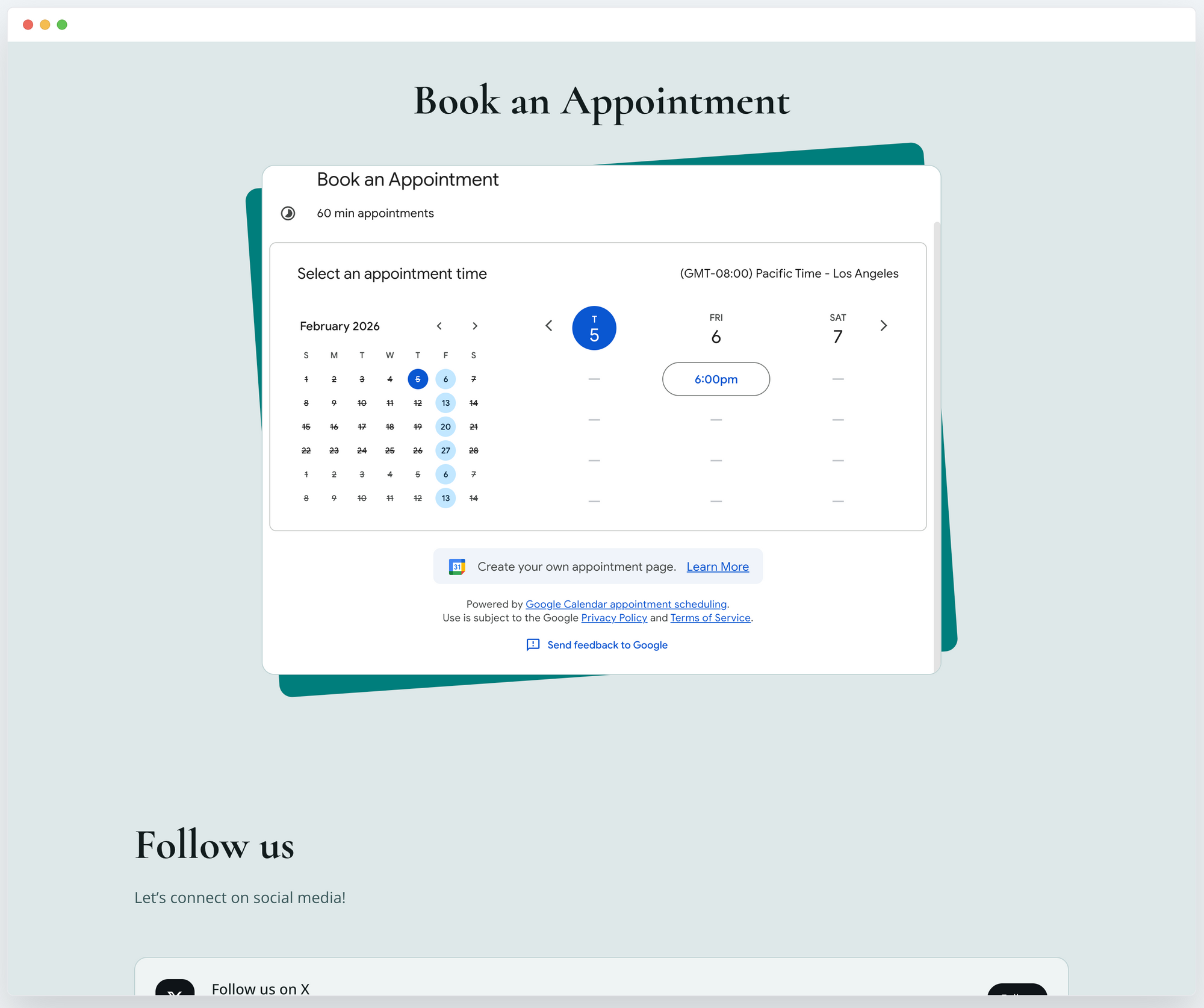
For service-based businesses, a calendar might be used for:
- Booking appointments or consultations
- Scheduling classes, sessions, or events
- Showing availability for upcoming dates
On a one-page website, this section often replaces separate “Booking” or “Schedule” pages.
When visitors see clear availability and can take action immediately, they’re more likely to:
- Stay on the site longer
- Engage with the page
- Complete a booking or inquiry
These behaviors help reinforce that the site is useful and relevant — especially for local searches where intent is high.
How to Use the Calendar Section Effectively
A calendar works best when it’s:
- Placed near the Contact or CTA sections
- Clearly labeled (e.g. “Book a Session” or “Check Availability”)
- Used consistently rather than abandoned
For example a tennis instructor might use this section to:
- Book private lessons
- Show weekly coaching availability
- Schedule junior clinics or group sessions
- Promote upcoming camps or special training blocks
On a simple website, the Calendar section quietly contributes to site context by showing that the business isn’t just described, but actively operating. For local and service-based businesses, that signal matters.
Contact Section
The Contact section is one of the most important sections on a local or service-based website. It’s where all of your key information comes together — and where both visitors and search engines look to confirm that your business is real, local, and reachable.
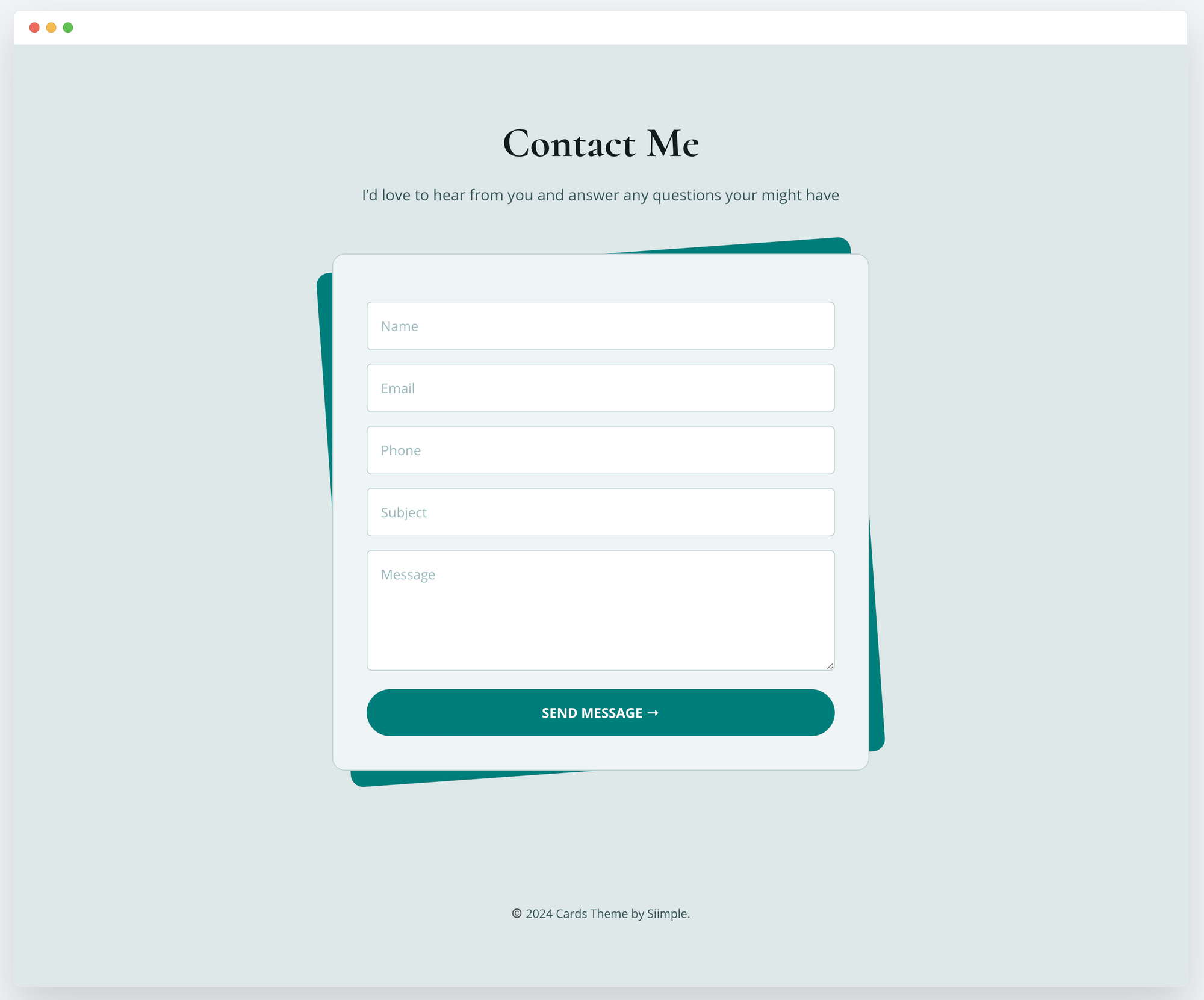
For local SEO, this section does more than collect inquiries. It reinforces core signals about who you are, where you operate, and how customers can contact you.
At a minimum, the Contact section should display:
- Business name
- Phone number
- City and state (or service area)
- Business hours
- A simple contact form or call-to-action
This information should match what’s listed elsewhere online (such as your Google Business Profile and directories)
When this information is present and clearly stated, it helps search engines associate the website with local search intent and match it to location-based queries.
Footer Section
From an SEO perspective, the footer plays a quiet but important role. It’s one of the clearest places where search engines look for business legitimacy, compliance, and consistency — especially for local and service-based websites.

While visitors may scroll past it quickly, search engines do not.
Including links to a Privacy Policy and Terms of Service in the footer is a baseline trust signal.
These pages help search engines confirm that:
- The site is operated by a real business
- User data is handled transparently
- The site meets basic legal and compliance expectations
This matters even more if:
- You collect form submissions
- You embed third-party tools (analytics, calendars, videos)
- You operate in or serve users from regions with privacy regulations
For SEO, these links don’t boost rankings directly, but their absence can weaken overall trust signals — particularly for service businesses competing in local results.
Country-Specific Compliance Signals
Different regions have different expectations around privacy and disclosure.
Including clearly labeled legal links in the footer helps demonstrate compliance with:
- GDPR (EU / UK)
- CCPA / CPRA (California)
- Other regional privacy frameworks
You don’t need to explain regulations on your homepage — but having the correct legal pages accessible from the footer helps search engines understand that the site is operating responsibly within applicable jurisdictions.
This is especially relevant for businesses that:
- Serve international clients
- Offer online booking or inquiries
- Use global platforms like Google Analytics or YouTube
Footer social media icons are less about driving clicks and more about entity confirmation.
Social Media Icons
When search engines see consistent links between:
- Your website
- Your social profiles
- Your business listings
it helps reinforce that all of these represent the same real-world entity.
For SEO purposes:
- Link only to active, relevant profiles
- Use official platforms (e.g. Instagram, Facebook, LinkedIn, YouTube)
- Avoid linking to unused or placeholder accounts
These links help search engines connect your site to your broader online presence, which supports trust and legitimacy.
Copyright Line
An up-to-date copyright line (e.g. “© 2026”) is a small but meaningful signal.
It indicates that:
- The site is actively maintained
- The business is currently operating
- The content hasn’t been abandoned
For local SEO, especially in competitive markets, these subtle freshness cues can help differentiate active businesses from outdated ones.
🌐 Off-Page SEO Strategies that Work Simple Websites
Everything up to this point has focused on what happens on your website — how it’s structured, how clearly it communicates what you do, and how consistently it reinforces your location and services.
That foundation matters. Without it, off-page SEO doesn’t work well.
But once your site is clear, structured, and sending strong on-page signals, something else becomes far more important:
What the rest of the internet says about your business.
This is where off-page SEO takes over.
Search engines don’t just evaluate websites in isolation. They look for external confirmation — signs that a business exists, operates locally, and is recognized beyond its own site.
For local businesses in competitive markets, this external validation is often what separates:
Businesses that sit just outside the map pack
From businesses that consistently show up
This is why backlinks, citations, and mentions carry so much weight for local SEO — especially once the on-page basics are already handled.
Backlinks Aren’t About Quantity — They’re About Context
For local businesses, backlinks don’t need to come from massive publications or high-profile blogs.
What matters more is context and relevance.
A backlink from:
- A local chamber of commerce
- A neighborhood association
- A trade organization
- A local supplier or partner
- A regional blog or directory
is often far more valuable than a random link from an unrelated website.
These links help Google connect your business to:
- A physical location
- A service category
- A real-world network
That context is incredibly powerful for local search.
Citations and Mentions Still Count
Even when there isn’t a clickable link, mentions still matter.
When your business name, address, and phone number appear consistently across:
- Business directories
- Review platforms
- Social profiles
- Local listings
Google uses that consistency as a trust signal.
Inconsistent information — different spellings, outdated phone numbers, mismatched addresses — can weaken those signals over time.
This is why off-page SEO isn’t something you “set once and forget.” It’s something you periodically check and reinforce.
Social Media’s Role in Off-Page SEO
Social media doesn’t directly boost rankings in a measurable, linear way — but it plays an important supporting role.
Active social profiles:
- Reinforce brand legitimacy
- Create additional mentions of your business
- Drive traffic to your website
- Increase the likelihood of being referenced elsewhere
For local businesses, social posts that reference real jobs, real locations, and real customers help tie your business to a geographic area — something search engines pay close attention to.
Why Off-Page SEO Often Matters More Than Tweaking Your Website
Many small businesses fall into the trap of endlessly adjusting their on-page SEO:
- Rewriting headlines
- Changing keywords
- Rearranging sections
While those things matter, they often produce diminishing returns once the basics are in place.
Off-page SEO, on the other hand, compounds.
Backlinks Build Domain Authority
Every backlink you earn becomes part of your website’s reputation.
Search engines don’t just look at how many links you have — they look at where those links come from and how consistently your business shows up across the web.
Over time, links from:
- Local organizations
- Industry platforms
- Trusted directories
- Partner websites
add up to something bigger: confidence.
This is often described as domain authority — not a score you need to chase, but a way to explain how established your website appears compared to others.
The more credible places that acknowledge your business, the easier it becomes for Google to trust your site — and the less you have to rely on constant website tweaks to compete.
For local and service-based businesses, this is why off-page SEO compounds.
Each mention, listing, and backlink quietly strengthens your position, making it easier for your website to surface when people search for services you offer.
A simple site with steady, real-world validation will almost always outperform a more complex site with none.
Each new mention, review, listing, or backlink strengthens the overall picture of your business on the web. Over time, that external validation can do more for visibility than another round of on-page tweaks.
For simple, local service websites in particular, off-page SEO is often the difference between:
A site that exists and a site that actually gets found.
Two plumbers might have very similar websites.
The one with stronger off-page signals — more reviews, consistent listings, and local mentions — is far more likely to show up in search results.
For most local service businesses like plumbers, SEO isn’t about endlessly changing the website.
It’s about pairing a clear, well-structured site with strong signals everywhere else on the internet.
On-page SEO is how your website is built and written so search engines understand what you do and where you operate.
Off-page SEO is everything outside your website — backlinks, listings, reviews, and mentions — that prove your business is real and trusted.
How Siimple Makes SEO Super Easy
SEO doesn’t need to feel technical or overwhelming to be effective—especially for local and service-based businesses. Siimple is designed to remove the most common points of friction that stop beginners from ever getting SEO right in the first place.
Instead of asking you to make dozens of decisions you may not fully understand, Siimple starts with a strong foundation and lets you focus on the parts that actually matter.
Pre-Made Templates Built for Local SEO
Siimple templates are designed specifically for simple, one-page and brochure-style websites. Each template includes all the core sections local businesses need—hero, services, features, proof, locations, FAQs, contact, and footer—already organized in a way that makes sense to search engines.
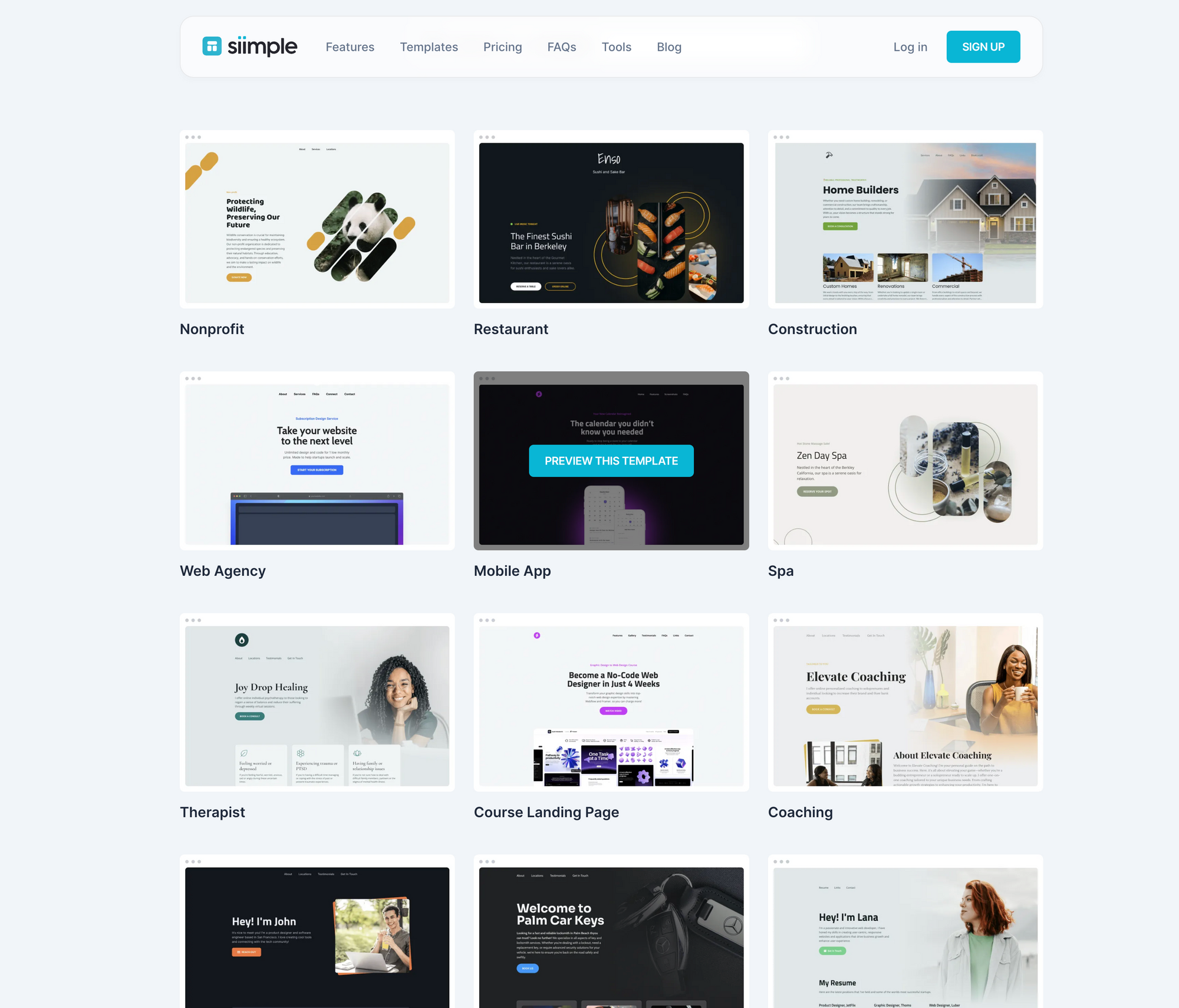
This means:
- Proper heading structure is already in place
- Sections are ordered logically
- Content areas are clearly defined
- Mobile layouts are handled by default
You’re not starting from a blank canvas or guessing how a page should be structured for SEO.
Built-In AI to Help You Write What Matters
Writing for SEO is hard when you don’t know what to say or how to phrase it.
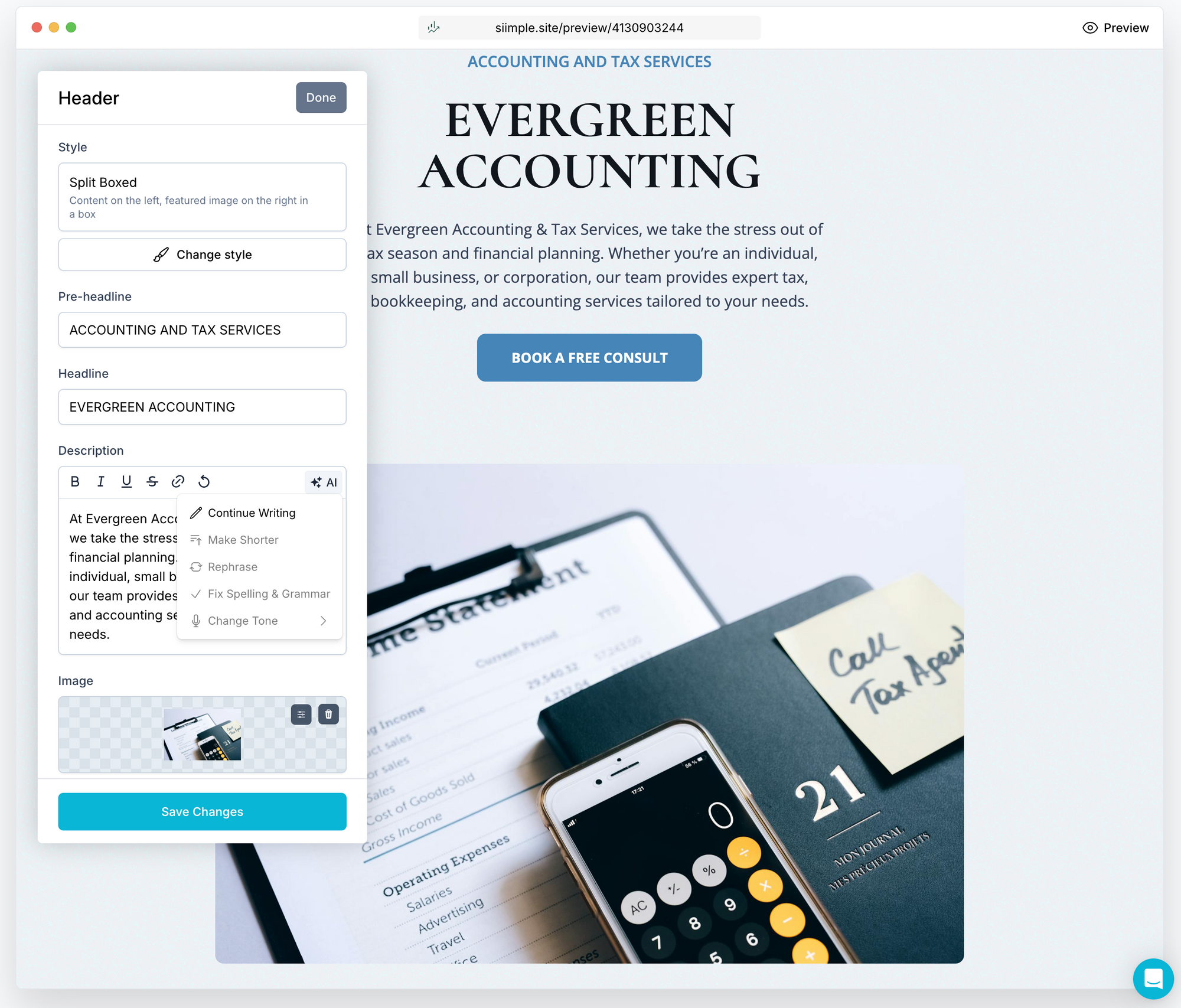
Siimple’s AI assistant helps you:
- Write clear, keyword-aligned section copy
- Describe your services in search-friendly language
- Naturally include locations and intent terms
- Avoid vague or generic wording
Instead of keyword stuffing, the focus stays on clarity—using the same language real customers use when searching.
Fast Page Speed and Lightweight Performance
Page speed matters more than most beginners realize.
Siimple sites are built to load quickly, with:
- Lightweight code
- Optimized assets
- No unnecessary scripts or bloat
Fast-loading pages are easier for search engines to crawl, easier to index, and better for users—especially on mobile, where most local searches happen.
Clean Code and Structure Search Engines Can Understand
Search engines don’t just read words. They read structure.
Siimple handles:
- Clean, readable HTML
- Sensible section markup
- Predictable layouts
- Crawlable page structure
This makes it easier for Google to understand what each part of your site represents—without you needing to touch code or worry about technical SEO details.
SEO Without Extra Pages or Maintenance
Siimple is intentionally built for businesses that:
- Don’t need blogs
- Don’t want dozens of pages
- Don’t have time to manage complex sites
Instead of adding more content for the sake of SEO, Siimple helps you get more value out of a single, well-structured page—supported by off-page signals like reviews, listings, and backlinks.
A Simpler Path to Being Found
SEO tends to work best when the fundamentals are handled well and kept consistent over time.
That’s where Siimple fits in. By removing technical guesswork, providing a clear and predictable site structure, and supporting the kind of plain, real-world language people actually use when they search, Siimple lets business owners focus on running their business instead of managing a complicated website.
For non-technical, local service businesses, that simplicity isn’t a limitation — it’s often the reason SEO finally starts to feel manageable and starts working at all.